Capability contracts
Translate design and deployment intent into explicit robot capabilities, constraints, assumptions, evidence requirements, and safety boundaries.
Platform
The 10Things platform organizes the artifacts that usually get scattered across robotics projects: robot models, capability assumptions, simulation runs, generated code, safety checks, telemetry, rollout state, and deployment evidence.
Platform overview
See how 10Things connects robot discovery, simulation, control generation, validation, and deployment operations into one platform path.
Translate design and deployment intent into explicit robot capabilities, constraints, assumptions, evidence requirements, and safety boundaries.
Preserve the chain from robot model to simulation evidence, generated code, hardware validation, deployment gates, telemetry, rollback, and governance decisions.
Architecture underneath
Ingest robot files, specs, and prototype context; prepare robot models, simulation assets, and capability contracts.
Support behavior authoring, imitation/teleoperation loops, and simulation-based training before hardware risk compounds.
Generate, review, test, and validate baseline control, perception, navigation, telemetry, and manipulation integration paths.
Model how humans, operators, and robots interact across tasks, environments, handoffs, and review loops.
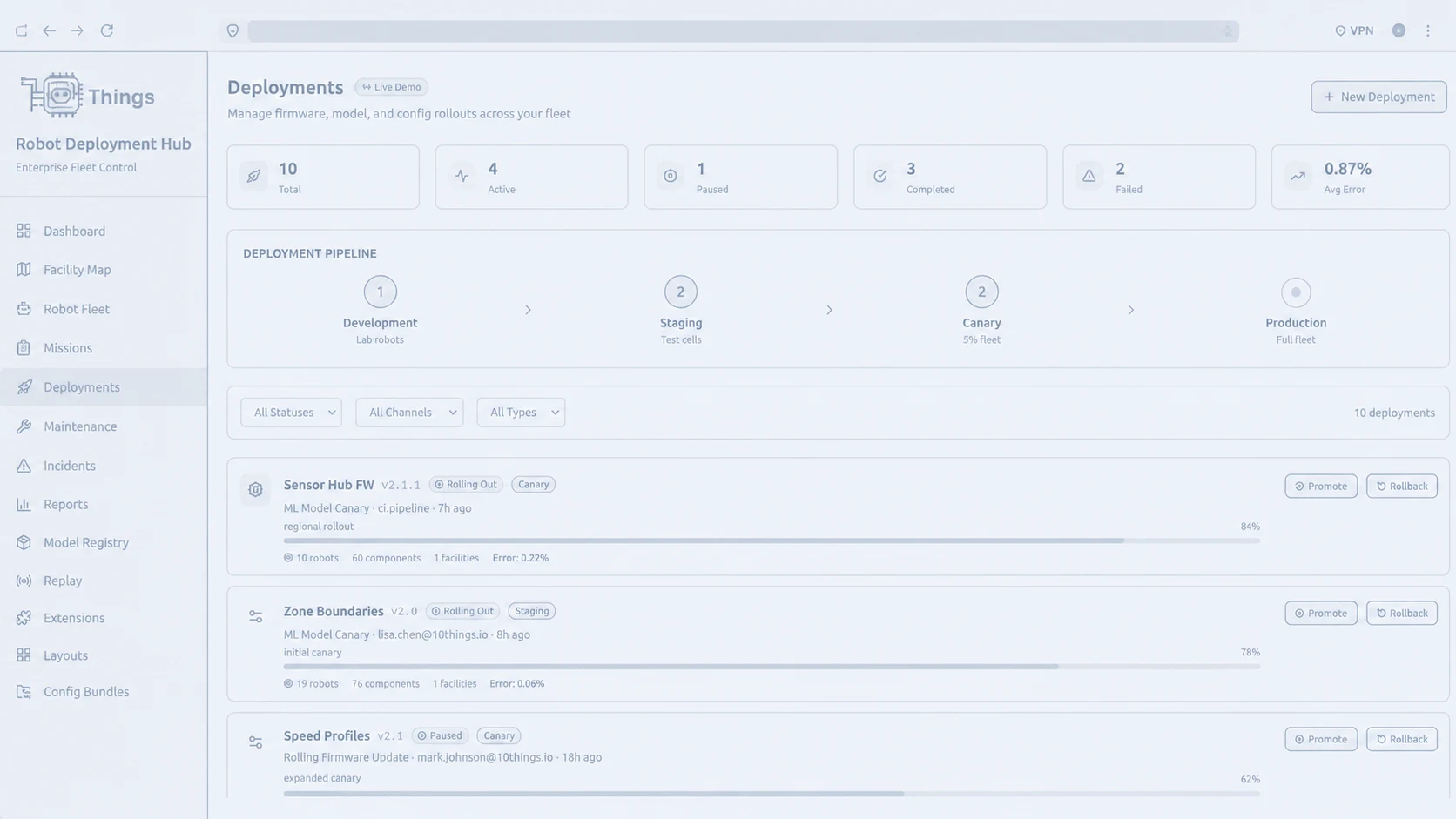
Package validated robot stacks for hardware deployment, policy checks, telemetry, OTA updates, rollback, and fleet rollout.
Provide operational visibility for users, robot state, platform health, governance, evidence history, and change review.